Property Division in Divorce
One of the issues facing a divorcing couple is deciding how their assets and property will be split after the divorce is final. The act of thoroughly and fairly dividing their property in a marital estate is known as property division.
The division of property can often be one of the most complex aspects of the divorce process, especially in Evanston, Chicago, Lake Forest, Oak Brook and the surrounding suburbs. Stern Mendez is committed to making sure you understand the process—and more importantly, feel satisfied with the way that the property is divided.
That’s why we’ve provided an overview of the process below and resources to make sure that you have a solid understanding of what property division in Illinois entails. If you have any questions, don’t hesitate to contact us at (847) 868-9584.
What is a marital estate?
When partners marry, they create a “marital estate” through which they jointly possess nearly all of the debts and assets acquired during the marriage. Upon divorce, the parties will equitably divide the marital estate between them with the help of an Evanston, Chicago, Lake Forest and Oak Brook divorce lawyer.
Marital property includes retirement accounts, savings accounts and even business interests, along with other physical property such as a house or vehicle. Regardless of how the property is titled, it is considered marital property if it was acquired during the marriage.
Marital property includes:
- Property acquired after the marriage
- Property acquired prior to the marriage in anticipation of the marriage (such as a house purchased for the couple to live in once married)
- Pre-marital property placed into joint ownership
- Non-marital property that loses its clear non-marital identity
Marital property excludes:
- Property acquired before the marriage
- Property inherited by one party
- Property gifted to one party
- Any growth and appreciation of non-marital property
Dividing Property in Divorce
Not only will the assets of the marital estate need to be divided during the divorce process, but also there will need to be an equitable share given to each party. Since a 50/50 split of all assets is usually not feasible, more often than not parties receive offsets for the disparate value of their debts and personal assets.
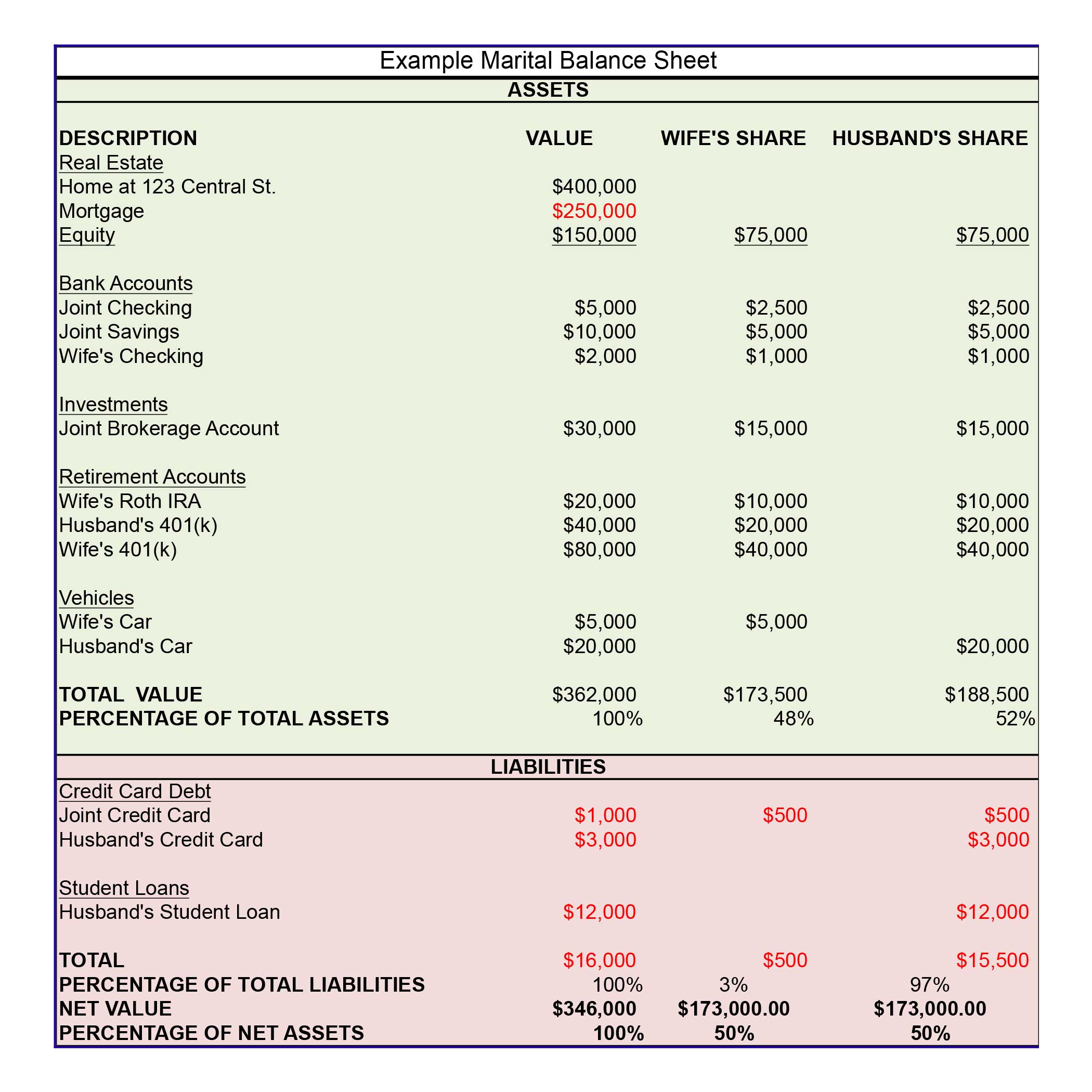
One very useful step is to create a marital balance sheet that helps calculate the percentage of property each spouse will receive. Stern Mendez has provided a sample marital balance sheet so that couples considering a divorce in Illinois may begin to understand how property could be divided.
See a sample Marital Balance Sheet >
Where Property Division Gets Complicated
Many couples disagree about the dividing of property in divorce, which can slow the progress of the case. It can be especially difficult because each party must acknowledge that his or her retirement account, car, home and other assets are not entirely his or her own. This is true regardless of the other spouse’s financial contribution to that asset (or lack thereof). If there is distrust or resentment between partners, property negotiations often have the potential to exacerbate it.
Another common issue in the division of property during divorce is dissipation, or the use of marital funds for a non-marital purpose during the breakdown of the marriage. The classic examples of dissipation are funds used for a partner’s affair, gambling or drug use. In many cases, a sum equivalent to the dissipated assets is deducted from the offending spouse’s share of the marital estate.
When discussing property division with your Illinois divorce lawyer, it is always best to be honest and provide him or her with as much information as you can. The more information you can provide your attorney, the better off you will be.
Contact a Divorce Lawyer in Evanston, Chicago, Lake Forest and Oak Brook
If you have any questions about property division in divorce or wish to discuss your case further, please contact Stern Mendez in Chicago, the North Shore, DuPage County or the surrounding suburbs so that we may review how the division of property relates to your specific case. Request a free consultation online or call us at (847) 868-9584.
FAQs About Property Division
What factors does an Illinois court consider when dividing property?
Illinois courts don’t look for an equal split. They look for a fair one, guided by several factors set out in state law.
The most common factors include:
- How long you were married
- Each spouse’s income, job, and ability to earn going forward
- Contributions to the marriage, including as a homemaker
- The value of each spouse’s non-marital property
- Age, health, and financial needs
- Whether the property division is happening instead of, or alongside, spousal maintenance
No single factor decides the outcome—a judge weighs the full picture. If you and your spouse signed a prenuptial or postnuptial agreement, some of this may already be settled.
What is a marital balance sheet, and why does my attorney want one?
A marital balance sheet lists every asset and debt in your marriage. It also notes each item’s value and whether it’s marital or non-marital property.
Building one early gives you and your attorney a clear, side-by-side view of the full estate before negotiations start. It also makes it easier to see whether a proposed split is actually fair.
Who keeps the house—and what are the options?
There’s no automatic answer—the marital home is treated like any other asset and divided equitably.
Common outcomes include:
- One spouse keeps the home and buys out the other’s share
- The home is sold and the proceeds are split
- Less often, both spouses continue to co-own it for a set period, such as until children finish school
-
The right choice depends on your mortgage, your finances, and your goals after the divorce, and if you’re also weighing whether to move out first, hear our attorneys break that down too.
Is marital debt divided the same way as marital assets?
Yes. Debt from the marriage—credit cards, loans, mortgages—is generally treated as marital property, just like assets.
It gets factored into the overall equitable split. It isn’t automatically assigned to whoever’s name is on the account.
That’s part of why a marital balance sheet matters. It accounts for what you owe together, not just what you own.
What is "dissipation of assets," and how is it different from hiding assets?
Dissipation happens when a spouse spends marital funds on something unrelated to the marriage. This usually happens after the relationship has already broken down. Common examples include spending on an affair, gambling, or excessive personal spending.
If the court finds dissipation occurred, it can award you a larger share of what’s left.
That’s different from a spouse hiding or concealing assets altogether. Worried that’s happening in your case? Our attorneys specialize in guiding clients through even the toughest situations.
What if my spouse and I can't agree on how to divide a specific asset?
You have options short of a trial.
Many couples work through disputed assets in mediation or a negotiated settlement. A professional valuation often helps settle any disagreement about what something is worth.
If those paths don’t resolve it, divorce litigation allows a judge to decide instead. Most property disputes are resolved before trial, and we can help you understand which path fits your situation.